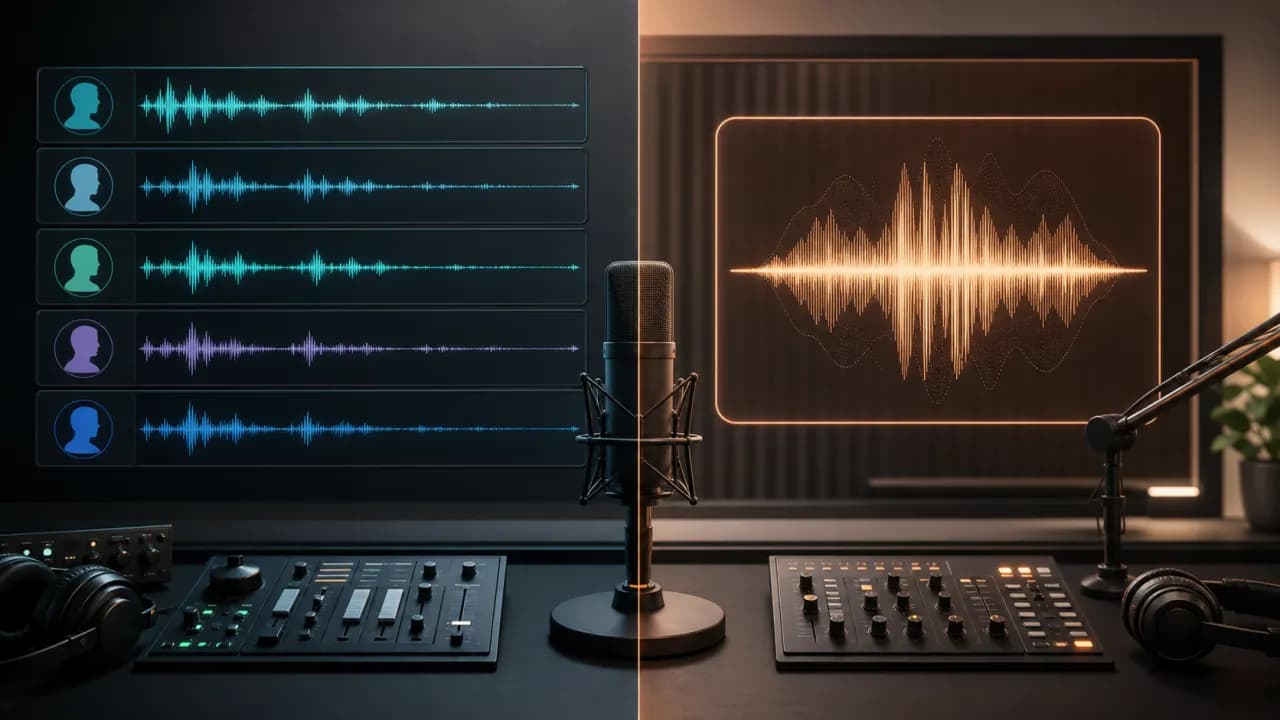
AI voiceover and voice cloning both turn text into spoken audio, but they solve different problems. A standard AI voiceover uses a ready-made voice. Voice cloning creates a synthetic voice based on an authorized speaker sample.
The right choice depends on whether you need speed and variety or a recognizable vocal identity. This guide compares the workflows, benefits, limitations, and responsible-use requirements.
Key takeaways
- Standard AI voices are faster to start and easier to test.
- Voice cloning is designed for a consistent, authorized vocal identity.
- Neither option removes the need for script and pronunciation review.
- Consent and access control are central to responsible voice cloning.
What is a standard AI voiceover?
A standard AI voiceover uses a voice already available in a text-to-speech library. You choose a language and voice, enter a script, adjust delivery, and generate audio.
It is useful when you need to start quickly, compare several styles, or produce content that does not need to sound like a specific person.
- Fast setup with no voice sample.
- Several voices can be tested against the same script.
- Suitable for explainers, ads, tutorials, courses, and prototypes.
- Easy to standardize across a team.
What is voice cloning?
Voice cloning creates a reusable synthetic voice from recordings of a real speaker. The sample captures characteristics such as tone, rhythm, and pronunciation so new text can be generated with a similar identity.
Only clone a voice when you have clear authorization from the speaker. Keep source recordings and generated output protected, and define who may use the voice.
AI voiceover vs voice cloning
- Setup: standard voices are ready immediately; cloning requires a suitable recording and processing.
- Identity: standard voices are generic library options; a clone is connected to an authorized speaker.
- Consistency: both can be consistent, but cloning supports a specific personal or brand identity.
- Variety: voice libraries make it easier to test different styles.
- Privacy: cloned voices require stronger consent, storage, and access controls.
- Use case: standard voices fit broad production; clones fit recurring, identity-led narration.
Choose a standard AI voice when...
- You need a voiceover today without recording samples.
- You are testing a concept or comparing audience responses.
- The narrator does not need to represent a specific person.
- You need several languages or styles.
- Multiple team members need a simple repeatable workflow.
Choose voice cloning when...
- The authorized speaker's identity is important to the content.
- A creator needs consistent narration across a large library.
- A company has permission to preserve a spokesperson's voice.
- Updating small lines without a new recording session has meaningful value.
Voice cloning should be a deliberate identity decision, not simply a quality upgrade. A well-matched standard voice can be the better choice for many projects.
Consent and responsible use
Get explicit permission that covers voice creation and intended use. Explain where the voice will appear, who can generate with it, how long it will be stored, and how authorization can be withdrawn.
Do not use a cloned voice to impersonate someone, mislead an audience, bypass verification, or create content the speaker did not authorize. Review platform disclosure rules before publishing synthetic media.
A practical hybrid workflow
Teams can use standard voices during scripting and rough editing, then switch to an authorized cloned voice for approved final narration. This avoids unnecessary use of the private voice during early iteration.
Keep a standard fallback voice for content that does not require identity-specific narration or when consent does not cover a particular use.
Frequently asked questions
Is voice cloning the same as text to speech?
Voice cloning is a specialized text-to-speech workflow that creates a voice from an authorized speaker sample. Standard text to speech usually uses ready-made voices.
Is a cloned voice always more natural?
Not necessarily. Naturalness depends on the sample, model, script, language, and delivery. A strong standard voice may perform better for a particular project.
Do I need permission to clone someone’s voice?
Yes. You should have clear authorization from the speaker and use the voice only within the agreed scope.
Can I keep a cloned voice private?
Vimorph distinguishes private voices from public library voices. Private voices should be protected with appropriate account access and responsible internal policies.